

Introduction
Why Laser Security Systems Are Gaining Popularity in India
The laser home security systems are becoming popular in India because of their cost effectiveness and high reliability. They have high sensitivity in detecting the unauthorized entries and also they have the ability to cover long distances without signal scattering. Moreover they offer reliable, low-power solutions for residential, commercial and industrial securities. They can be integrated with smart IoT (Internet of things) devices to send real time alerts.
Where These Systems Are Commonly Used
The laser home security systems are used in the following locations for security purposes.
Perimeter protection: Widely used for protecting fence lines, driveways, gated entrances, backyard perimeters, and some hardly seen parts of the perimeter.
Access Points: Mainly it is used on entry openings like across windows, doors of garages, front doors, and entry gates to detect forced entry of persons and animals.
Remote Areas: Also, it is useful in remote areas such as sheds, farmhouse backyards, and cattle stock at farms.
Highly Risky Areas: Interior areas where you have valuable metal or hot cash stored, staircases, or a specific room or place.
Main Areas of application
Residential Surveillance: To get mobile alerts on correct times, the laser home security systems are usually integrated with other smart home systems to achieve better performance.
Detecting unusual entries : This feature sends an alert immediately after detecting an unusual intrusion in the premises.
Weather protection: This system ensures the high level of security, even during bad weather conditions. The system usually designed with weather-resistant materials.
These systems mainly includes a Laser transmitter, and a receiver, providing a reliable and low-cost option for home security in India
How a Laser Home Security System Works
Basic Working Principle of Laser Security System
A security system that works based on LASER technology detects the intrusion and alerts the home owners.
The basic working of this system is simplified as following :
The Security System used to transmit a narrow beam of light through laser in the air or passage.
Such transmitted light beam travels in the air until it is obstructed by a fixed object in front of it.
The beam of light on hitting the fixed object gets reflected back into the device which is having a sensible detector inside.
The detector continuously keeps on measuring the amount of light falling on it after reflection.
For example when the Laser Security System is idle with no one coming into the path of the light beam, there will always the same amount of light coming back to the detector constantly.
Whenever any burglar unauthorized persons tries to pass through the passage, they have to obstruct the invisible light beam, causing a change in the amount of light getting back to the sensor. The sensor immediately realizes that someone is entering in the path and it triggers the alarms to alert the home owner.
The alarm goes off with a loud sound to scar the intruder as well as gives the signal to the neighbors or the security personnel of the premises for action.
Role of Laser beam and sensors
Laser Beam
The term Laser stands for Light amplification by the stimulated emission of radiation. The laser beam serves as the primary detection line across a secured area.
Creating an invisible barrier: A laser transmitter projects a concentrated, narrow light beam, often invisible, towards a specific receiver usually a LDR.
High range of coverage: The laser light always travel in a straight line and doesn't scatter out like a standard light, because of this property it can cover distances from a few meters up to hundreds of meters across passages, backyards, or huge property boundaries.
High Accuracy: The advantage of the narrow light beam allows for precise monitoring of exact entry points, such as doors, windows, or any specific place.
The Role of the Sensor (Receiver)
The sensor is usually a Light Dependent Resistor (LDR) or a photo detector, which performs like as a "human eye" that continuously online with a laser beam.
Constant Monitoring: Under normal circumstances, the sensor is placed in such a way that it directly gets focused by the laser beam, maintaining a constant electrical signal.
Detecting Interruptions: If an intruder (human), animal, or object interrupts the beam's path, the invisible light beam gets obstructed, and the continuous light falling on the sensor gets disturbed.
Triggering the Alarm: When the beam is interrupted, the sensor immediately detects an immediate change in the received light intensity. This variation, signals the control unit to activate alert mechanisms like sirens, buzzers, or smart mobile notifications instantly.
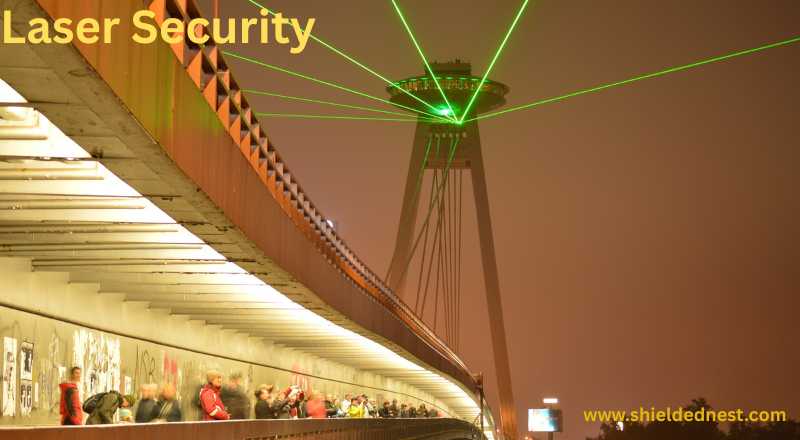
What Happens When the Beam Is Interrupted?
When the laser beam connected is interrupted, it reduces or stops the light falling on the sensors, usually LDR (Light dependent resistor)’s. Immediately the sensor recognizes the change in intensity of falling light and it gets its dark resistance and immediately sends the signals to the control unit that someone is crossing the barrier. The control unit takes the next action to alert.
Components Required for Laser Home Security System
Laser Transmitter
The first one is a laser transmitter. It is considered as the heart of the system. It emits a focused light beam that travels in a straight line.
In a typical setup, this laser beam is directed towards a sensor placed on the opposite side to get hit by the beam. As long as the beam remains unblocked, everything is normal and the amount of light falling on the sensor remains constant. But when someone crosses the path and blocks the beam, there is an interruption in the light flow. Suddenly the amount of light falling on the sensor gets cut down, and immediately the system detects there is something happening crossing the line.
For installation, you can go for a simple or basic laser pointer module, which is affordable and easy to get in in the market.
Photodiode / LDR Sensor
Second important thing is Sensor, usually that can be either photodiode or LDR. This component is considered as the “eye” of the system. It is the one that receives the laser beam emitted from the transmitter.
A photodiode responds quickly as it is more sensitive to light.
An LDR (Light Dependent Resistor) is cheaper. It is good and easier to use for basic projects.
When the laser light falls on the sensor, it maintains a stable electrical signal. But if the beam is interrupted (for example, when someone cross the beam), the signal gets interrupted and the sensor recognize the intrusion and triggers the alarm.
Alarm or Buzzer
Next important component is the alarm or buzzer. It is the output unit of the system. Its job is to alert you by siren or alarm at the time of intrusion.
As soon as the constantly flowing laser beam is interrupted, the control circuit activates the buzzer, producing a loud sound. This loud sound acts as an immediate warning that helps you to take the necessary action.
You can also replace the buzzer with a siren for loud sound. Even you can connect it to a smart notification system to avail advanced technical setups.
Power supply
Every electronic system needs electric power to function, and this is common to all.
The power supply provides the required electric voltage to all components starts from the laser module, sensors, and the circuit.
Please note for small projects, you can use: Batteries (like 9V or AA cells) A DC adapter. Make sure the power supply is stable all the time to get over all efficient performance of the device,
Control Circuit (Transistor/Relay)
This can be considered as the “brain” of the system. It processes the signal received from the sensor and activates the alarm on time.
A basic transistor is commonly used in simple circuits to switch the buzzer ON or OFF.
A relay is used when you want to control higher voltage devices or connect external systems.
When the sensor detects an interruption in the laser beam, the control circuit immediately triggers and switches ON the buzzer. This assures a fast and reliable response to any intrusion taking place.
Laser Home Security System Circuit Diagram
Simple security system Circuit Diagram and Explanation
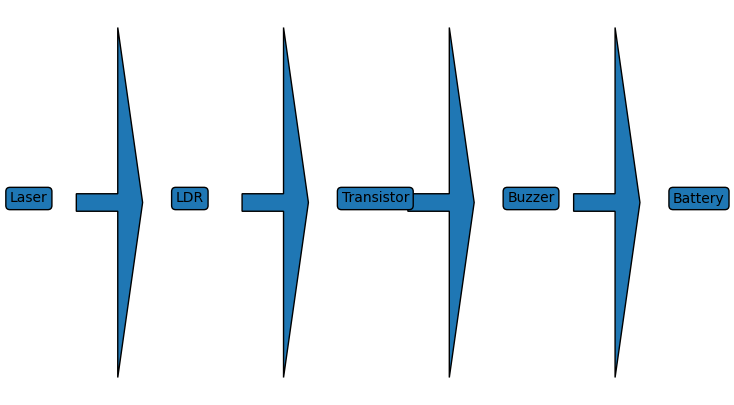
In this basic security system’s circuit diagram, the laser transmitter is constantly emits a beam of light towards the LDR (Light Dependent Resistor).
When the laser beam falls on the LDR, it maintains a constant intensity of light throughout the circuit. The LDR is further connected to a transistor, which acts like a switch.
As long as the light is not blocked by any object, the transistor keeps the buzzer in OFF condition. But whenever, someone crosses the laser path, the light flowing to the sensor is interrupted, thus causing a change in the LDR’s resistance (Dark resistance) because of reduced or no light fall on the sensor.
This change in the intensity of falling light, activates the transistor, to make the buzzer turn ON for alerting you about the intrusion that has happened. The entire system is powered by a simple battery backup.
Connection Details of the circuit
Installing a laser home security circuit is very simple if you follow the following steps carefully:
Connecting the Power Supply to the circuit
Initially connect the DC power supply to the circuit. Ensure the positive and negative terminals are correctly joined on the terminals to avoid damages in the circuit.
Power the laser module and position it so that the beam is directed fall in to the sensor’s surface. Align the beam properly in a straight line to get an accurate detection.
Setting Up of the Laser Transmitter
Power the laser module and position it so that the beam is directed fall in to the sensor’s surface. Align the beam properly in a straight line to get an accurate detection.
Connect the LDR Sensor
Connect one end of the LDR sensor to the power supply and the other end to the transistor’s base. The LDR (sensor) will begin receiving the laser light continuously.
Add the Transistor (Control Switch)
Connect the transistor so that it receives the signal from the LDR. It will act as a switch to control the buzzer based on light interruption.
Connecting the Buzzer
Connect the buzzer to the output side of the transistor. When the transistor is activated, immediately the buzzer will turn ON and start producing sound to give alert.
Check the Circuit
Once all connections are done, turn on the power and test the system. Interrupt the laser beam with your hand or ask some one to pass through and check the buzzer for its action.
How Each Component Functions in the Circuit
Every part of the system plays a prominent role in detecting the intrusion and triggering the alarming systems.
Please go through the following content to know about the functionality in detail.
The laser transmitter transmits a focused beam of light, constantly towards the sensor in a straight line. This beam acts like an invisible security line. As long as this line is not disturbed from any external objects, the system remains stable and calm. You can think of it like a watch guard watching the laser beam all the time.
The transistor (control circuit), acts like a switch. It receives the signal coming from the sensor. When the laser beam is present and the emission is continuous, the transistor keeps the circuit in an OFF state.
The buzzer (alarm) remains silent when everything is normal. But when the transistor turns ON, the buzzer immediately produces sound to warn about an intruder.
The power supply usually a battery, provides the power needed for all the components to work efficiently. It the most important component of the system, without this, the system cannot function.
In simple terms, the laser creates a straight line path, the sensor observes the emitted light from beam, the transistor decides what to do next, and the buzzer alerts you if something goes wrong.
These all specified components work together to create a basic but effectively working security system.
Laser Home Security System Project Explanation
DIY Project Guide
Creating your own laser based home security system is a fun and practical and useful project. Follow the following shown simple steps to create a basic working model at your home in your budget.
Step 1: Collect all the required Components
First, start the process of purchasing all the required components such as a laser module, LDR or photodiode, transistor, buzzer, resistors, connecting wires, breadboard, and a power supply (battery or adapter). Keeping all the needed things ready will make your work more easier.
Step 2: Seting Up the Circuit on a Breadboard for primary testing
Use provided breadboard for assembling the circuit for basic testing. This helps you to build the system without soldering and makes it easy to modify connections if needed. You can try trial and error on bread board before assembling the components on PCB (printed circuit board).
Step 3: Connect the LDR and the Resistors to the circuit
Locate the LDR on the breadboard and connect it with a resistor to form a voltage divider circuit. This setup helps the sensor to detect changes in light intensity of the laser beam.
Step 4: Connect the Transistor to the circuit
Connect the transistor to the LDR circuit. Then the transistor will become a switch that controls the function of a buzzer. Make sure the Transistor’s base, collector, and emitter are properly connected to the board.
Step 5: Connect the Buzzer to the circuit
Attach the buzzer to the output of the transistor. When the transistor gets activated, it will allow current flow that turns ON the buzzer.
Step 6: Power the Circuit using Battery
Connect the backup battery or DC power supply to the circuit to energize. Fully check all connections before switching the system ON to avoid short circuits or any other problems.
Step 7: Align the Laser Beam
Keep the laser module such that its beam falls straightly on the surface of the sensor (LDR) without ant disturbance. Proper alignment is very important for accurate functioning of the system.
Step 8: Test the functionality of the System
Turn on the power and test your setup. Try blocking the laser beam with your hand. If everything is connected correctly, the buzzer should sound immediately getting triggered.
Step 9: Secure the Setup
Once the system is tested and working, you can fix the components permanently in the required place.
Common Mistakes to Avoid
Creating a laser home security system is simple, but remember, small mistakes can affect it’s over all performance. Here are some common errors you should avoid during installation:
1. Perfect Laser AlignmentOne of the most common mistakes that people used to do is, not aligning the laser beam properly with the sensor (LDR). Even a very small alignment errors can cause frequent false alarms in the circuit.
2. Loose or Wrong ConnectionsAvoid incorrect wiring or loose connections in the circuit. It can break the circuit. Always double-check each connection for perfectness, especially the transistor pins (base, collector, emitter).
3. Using Incorrect Resistor Values
Use proper resistance values with allowed tolerance in the circuit. If the resistor value is too high or too low, the sensor may not respond properly to changes in light intensity. This can lead to error.
4. Unstable Power SupplyAlways use a proper power supply, using a weak battery or fluctuating power source can cause the system to behave abnormally.
5. Ignoring Ambient Light InterferenceStrong sunlight or room’s bright lighting can affect the LDR’s performance. Try to place the system in a light controlled environment or shield the sensor from unwanted light.
6. Not Testing the Circuit Properly
Some people skip or ignore proper testing after the installation. But it is a bad practice. Always test the system multiple times by interrupting the laser beam to ensure its smooth functioning.
7. Poor Component PlacementPlacing components too far or in a unstable positions can surely disturb the setup. Make sure everything is securely fixed, especially give special care to the laser and sensor.
Uses of Laser Home Security System
Don’t think, Laser home security systems are just for small projects. They are used in many real-life scenarios, where safety and protection are given importance. Let’s see some common uses.
Home Security Applications
When we install the system for homes, the laser security systems are used to monitor and protect the entry points of the home like doors, windows, and balconies. Whenever someone enters by crossing the laser beam, the system immediately sends an alarm to alert the home owner. This makes it a useful and low-budget option for basic home protection. Many people also use it as a DIY security project to understand how real security systems work.
Bank and Museum Security
Banks and museums require a higher level of security for valuable items like cash, jewelry, and documents and historical items. Surely the need this kind of security.
Industrial and Warehouse Protection
Factories, warehouses, and storage units are often contain costly goods and equipment.
Laser security systems can be installed around storage areas, entry gates, or restricted zones. If somebody enters, the system alerts the security staff immediately after detecting the intrusion. This helps in reducing theft, damage, and restricting the unauthorized access.
Military and High-Security Zones
In defense areas and other high-security zones, laser systems are used for strict surveillance and intrusion detection. They help monitor country borders, restricted zones, and sensitive installations. Since these systems can detect even small interruptions, they provide an additional layer of security. In such places, laser systems are often combined with the other advanced technologies to get a maximum efficiency on security.
Advantages of Laser Home Security System
Laser home security systems offer several benefits, especially for beginners and small-scale security requirements.
Let’s look at the main advantages in simple terms.
High Accuracy and Fast Detection
One of the biggest advantages of a laser security system is its accuracy.The system works by creating a direct light beam between the transmitter and the sensor. If anything interrupts this beam, it is detected instantly.
This means the response time is very fast, and the alarm is triggered without any time delay. Even a small movement across the beam can activate the system, making it highly reliable to the homeowners.
Cost-Effective Security Solution
Laser security systems are very affordable compared to advanced the CCTV or smart security systems.Most of the components like laser modules, LDRs, and buzzers are low in price and easy to get in any local markets in India. This makes it a great option for students, DIY enthusiasts, and homeowners who need the basic security in low-cost.
Installation and Maintenance – An easy process
Another major benefit is that the system is easy to set up. The installation is very simple.You don’t need advanced technical skills to build or install it. With basic knowledge of electronics, anyone can assemble the system using the simple tools.Remember, maintenance is minimal, only need to check proper alignment of beam and the wiring regularly.
Works Without Internet Connection
Unlike modern smart security systems, a laser security system does not require an internet connection for the functionality.
It works independently using a simple electronic circuit. This is especially useful in areas where internet connectivity is not available, poor availability of internet, on unreliable signal levels. Even during network failures, the system will continue to function without any problems.
Disadvantages of Laser Home Security System
There is no doubt, the laser home security systems are very useful, but they also have their own limitations to be considered. Understanding these limitations properly will help users to use the system more effectively.
Sensitivity to Environmental Factors
Laser systems can be affected by the environment. Things like dust, smoke, fog, or strong sunlight can affect the laser beam significantly. This may cause false alarms or reduce the system’s performance.
Requires Proper Alignment
The system depends heavily on the correct alignment between the laser and the sensor.If the laser beam is not properly aligned at the sensor (LDR or photodiode), the system may not work properly. Even a very small shift in position can break the connection and trigger unnecessary false alarms. So, always be careful while doing setup and proper regular checking is very essential.
Limited Coverage Area
A basic laser security system can only cover a small area.It usually works in a straight line between the laser and the sensor. This means it cannot monitor large spaces or multiple entry points at the same time. To cover a bigger area, you would need multiple laser setups, which can increase complexity on installation and increase in cost.
Types of Laser Security Systems
Laser security systems are available different types based on the number of beams they use and amount of area they can cover.Let’s look at the common types in simple terms.
Single Beam Laser Security System
This is the most basic type of laser security system. It uses one single laser beam directed to the sensor. When someone crosses or breaks the beam, the alarm is triggered to give alert. This type is easy to build and low-cost, making it perfect for small areas like a single door or window. It is commonly used in DIY projects and beginner-level setups.
Three-Way Laser Home Security System
This system uses three laser beams placed in different directions.These beams can cover multiple entry points or create a wider security zone. For example, you can place one beam at the door, one at a window, and another at a hallway. If any one of the beams is interrupted, the alarm will activate. This setup offers better protection compared to a single beam system. But it will cost more for installation.
Advanced Multi-Beam Systems
Advanced systems use multiple laser beams to create a strong security network.These beams are often arranged in a grid pattern to cover big areas. They can detect movement more accurately and reduce blind spots. Such systems are used in high-security required places like banks, warehouses, and restricted zones.
Some advanced versions are also available in the market that can be connected to cameras, alarms, or smart systems for better monitoring and control.
Laser Security System vs Traditional Security Systems
Let’s compare the laser security systems with other common security methods in a simple way.
Laser vs CCTV Cameras
Laser security systems can detect intrusion when the beam is broken or interrupted, while CCTV cameras record video of what is happening at the moment.Laser systems are cheaper and give instant alerts, but they do not show the physical details of the intruder. CCTV cameras provide visual proof, but they are more expensive and need storage and sometimes need stable internet connection.
Laser vs Motion Sensors
Laser systems work with a straight beam of light, while motion sensors detect the real movement in the area. Laser systems are more precise because they trigger only when the beam is interrupted. Motion sensors can cover a wider space, but sometimes they give false alarms due to pets or small movements.
Which One Is Better for Home Use?
It depends on your home requirements and budget you are willing to spend.If you want a low-cost and simple alert system, a laser security system is a better choice. If you need full monitoring and recording, CCTV is better. For wider area detection, motion sensors are useful.Many people use a combination of these systems for better and efficient home security.
Tips to Install Laser Home Security System at Home
Installing your laser security system perfectly can enhance its performance and reliability. Following are some simple tips to follow.
Best Placement for Maximum Coverage
Locate the laser and sensor at important entry points like doors, windows, or hallways.Make sure the beam covers the path where an intruder is most likely to pass through. Install the laser at a proper height so it cannot be avoided simply.
Indoor vs Outdoor Setup
Laser systems work best for indoors where there is less or no disturbance.For outdoor use, natural factors like sunlight, dust, rain, or fog can affect its performance. If you install it outside, try to protect the sensor and laser with a cover.
Safety Precautions While Using Laser
Always use low-power laser modules for safety.Avoid pointing the laser directly into anyone’s eyes. It can be harmful to eyes.Also, ensure the system is placed where children cannot play or tamper with it
Future of Laser Home Security Systems in India
Laser security systems are slowly evolving with the developments of new technologies. In the coming years, they are expected to become more advanced and widely used in India.
Integration with Smart Home Technology
In the future, laser security systems can be connected with smart home devices. This means you can receive alerts on your mobile phone if the laser beam is interrupted. It can also be linked with smart alarms, cameras, and home automation systems for better control and performance.
AI-Based Laser Security Systems
With the use of Artificial Intelligence (AI), laser systems can become more smarter.AI can help the system to understand the difference between actual real threats and small negotiable disturbances. This reduces false alarms and improves more accuracy. It can also work together with cameras for better monitoring.
Growing Demand in Urban Homes
In cities, due to the increase in thefts, robbery and burglary, people are becoming more aware of home security. Many homeowners are looking for affordable and easy-to-use security solutions. Laser security systems can become a popular choice because they are simple, low-cost, and effective for basic protection.
Frequently Asked Questions (FAQs)
Conclusion
Final Thoughts on Laser Home Security System
A laser home security system is a simple, affordable, and more effective way to protect your home.It works by detecting any interruption by a laser beam and quickly alerting you through an alarm. This makes it a great choice for basic security requirements, especially for small areas like doors and windows. It is also a good learning project for students and beginners interested in working on electronic projects.
Is It Worth Installing in 2026?
Yes, it is worth installing if you are looking for a low-budget and easy security solution.Always keep in mind that it may not be a replacement to the advanced systems like CCTV or smart security devices, it can still provide an extra layer of protection. For better safety, you can also combine it with other advanced security systems.
Overall, it is a smart and budget-friendly option for homeowners in 2026.
