

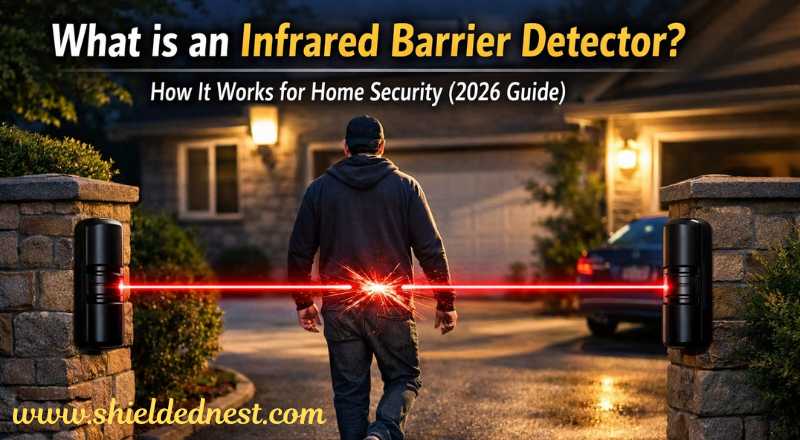
In today’s world of technology, security is no longer considered a luxury – but it has become almost a necessity in every field. If you decide to secure or protect your office, home, or any of your commercial properties, the first thing that comes into play is having the right security devices in the right place. One of the most reliable and widely known and used technologies in the present day is the infrared barrier detector.
Infrared barrier detectors usually use invisible infrared light beams for the detection of any movement or intrusion in the premises. They are considered good for their perfection in accuracy, their quick response, and their capability to work both indoors and outdoors. In this article, let’s see what an infrared barrier detector is, its functions, advantages, etc.
What is an Infrared Barrier Detector?
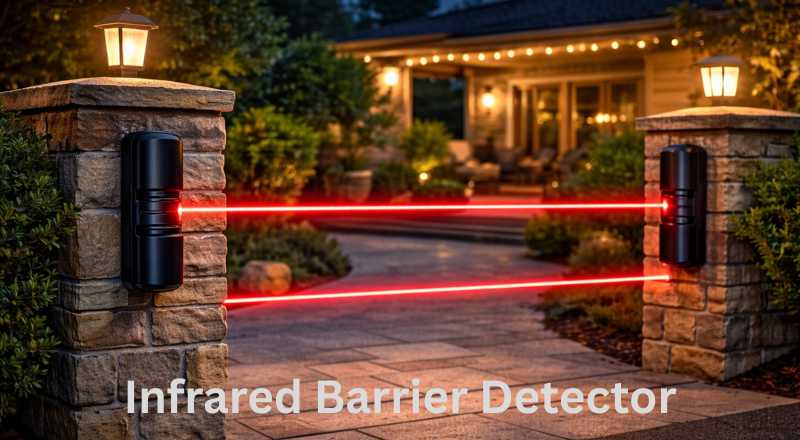
By definition, an infrared barrier detector is a device that uses infrared light beams (invisible) to detect if an object is moving through a monitoring area.
The device consists of two main
parts:
Transmitter – Transmits an
invisible infrared beam.
Receiver – detects the beam and
triggers an alarm when the beam gets obstructed.
For example, let’s consider a man walking in the monitoring area, and when he interrupts the beam immediately, it will be detected, and an immediate alert message will go from the system to the alarm devices or the security control panel. This action prevents the entry of unauthorized persons on the premises.
How it is different from other sensors:
The passive infrared (PIR) motion detectors sense body heat and recognize objects. In PIR, the device will not produce infrared but will only detect infrared radiation transmitted by objects. But infrared barrier detectors sense beam interruption. It will send the self-produced infrared and detect the interruption and alert.
The microwave sensors are used to emit microwaves and receive the reflection to notice any movement in the space. But IR motion detectors are focused and have a fixed path.
Working Principle of Infrared Barrier Detectors
The working principle
is simple but effective:
Beam Transmission
The transmitter continuously transmits and sends a narrow
infrared beam to the receiver in a set path. But this beam is invisible to the
human eye.
Beam Reception
The receiver constantly checks for the incoming beam. As
long as the beam is intact, the system remains in standby mode.
Interruption
Detection
If an object, human, animal, or vehicle interrupts the beam,
the receiver instantly detects the absence of the signal and acts immediately.
Alarm Activation
Once the interruption is detected, the device sends a signal
to the connected security control panel or alarm system, triggering sirens,
lights, or notifications as per the setup.
Types of Infrared Barrier Detectors
There are two major types.
Active Infrared (AIR) Sensors—Having both a transmitter and receiver. It is best for perimeter security.
Passive Infrared (PIR) Sensors – Detects the infrared radiation emitted by other objects (mainly body heat). Common for indoor motion detection purposes.
For example, if you install a set of active infrared beams across your driveway, the system will trigger an alert as soon as someone tries to cross it.
Applications of Infrared Barrier Detectors
Infrared barrier detectors are versatile and can be used in different environments:
a) Home Security
Installed at gates, driveways, doors, and windows.
Protects gardens and backyards from intruders, mainly humans or animals.
Used as an early warning before someone reaches the main building from the gate or entrance.
b) Commercial Security
Offices and shops use them at entrances and display areas.
Banks and warehouses use them to protect restricted areas.
c) Outdoor Perimeter Protection
Used in fences, boundary walls, and parking areas.
Often combined with CCTV cameras for visual confirmation.
d) Industrial Automation
Protects workers from entering hazardous zones in factories.
Used in production lines to detect product movement.
Plays an important role in Industrial safety.
Advantages of Using Infrared Barrier Detectors
Here’s why many security professionals recommend them:
High Accuracy
These devices detect only when something physically interrupts the beam, which helps reduce false alarms.
Weather Resistance
Especially the outdoor models are designed and made with caution to sustain and withstand heavy rain, fog, and dust. Hence, it is recommended for outdoor use in all seasons and weather conditions.
Low Power Consumption
They consume very little electric power compared to other security devices in the market.
Easy Integration
It can be connected to alarms, sirens, lights, or smart home security systems easily.
Customizable Range
Basically designed to cover certain meters. But if required, it can be customized to cover hundreds of meters.
Limitations and Considerations
Certainly, they are highly effective, but there are a few points to keep in mind while using:
Line-of-Sight Requirement – The transmitter and receiver must be directly aligned for the system to work. The transmitter and receiver must be in a purely straight line. The straight line alignment is very important.
Sunlight Interference – Strong sunlight or reflective light of surfaces can sometimes affect the performance.
Maintenance Needs – Dust, insects, or spider webs on the lenses can block the beam. So the system must be checked on a routine basis.
Fixed Coverage – They only detect interruptions in the set beam path. While setting the path, be careful.
Cost and Installation
The cost of an infrared barrier detector purely depends on its range, number of beams, and brand. The basic model can cost around Rs. 5000, and the advanced models can go up to Rs. 25000. (The cost may vary with respect to the place you live.)
Basic models are good enough for indoor use.
Advanced models are good for outdoors since they are good for distance and weather-proofing.
Maintenance Tips for Long-Term Performance
To ensure your infrared barrier detector works efficiently for years:
Clean the lenses regularly – use a soft cloth to remove dust, dirt, or water spots.
Check Alignment – Ensure the transmitter and receiver are perfectly aligned.
Test Monthly—Check the alarm triggering by manually interrupting the beam.
Protect Cables—Keep wires safe from rats and weather damage.
Conclusion
An infrared barrier detector is a simple and powerful tool for both home and commercial security. Its ability to detect intrusions quickly and accurately makes it an essential part of a layered security system.
Whether you want to protect your home perimeter, secure a business entrance, or monitor restricted areas, this device offers reliability, low maintenance, and strong protection.
If you’re serious about upgrading your security system, consider integrating infrared barrier detectors with CCTV cameras and alarm systems for complete safety and security.