

Introduction
These days, we are living in the world of technology. In the olden days, we used some traditional ways to protect our homes from thieves and burglars. But today we have to agree that the burglars have become too smart in their work. To get protection from them, our traditional security system is not enough, and we need to upgrade.
Why Motion Sensors Are Essential for Home Security in India
As discussed above, the up gradation is very important, especially for growing countries like India. As we are mainly focusing on “motion sensors for home security in India, " let's analyze accordingly.
The motion sensors offer round-the-clock surveillance, and this can surely reduce the risk of burglary up to 300%; that's why the motion sensors are considered crucial for home security in India. They serve as a proactive measure, with affordable prices and in the first line of defense to provide real-time alerts to smartphones, controlling alarm systems, and stopping the intruders by activating lights.
These systems are considered best for securing perimeter fencing, entry points, and neglected spaces like basements, backyards, etc.
Growing Demand for Smart Home Security Systems in 2026
In 2026, there will be a significant increase in demand for smart home security systems because of AI-powered, networked gadgets and a change in the view of security as an essential rather than a luxury. The world's smart home security services market is expected to reach a value of over $43 billion by 2026, with a compound annual growth rate (CAGR) of more than 15%. AI-powered surveillance, biometric access, and smooth integration through the Matter standard are considered important areas.In this article, you will be explained more about motion sensors and their working principles, types, advantages, disadvantages, benefits, and mainly, why we need motion sensors for home security in India.
What Are Motion Sensors?
Simple Definition
In a simple definition, a motion sensor is an electronic device that detects movement in a specified area and triggers a response immediately after detection, such as turning on lights or sounding an alarm. Technically, they work by sensing the change in heat (infrared) or emitting waves ( microwaves/ ultrasonic) to detect when something moves across their field of view.
Role of Motion Sensors in Modern Home Security Systems
The following are the important roles of motion sensors in modern
Technology Intrusion Detection: Most of the times motion sensors are in the front line of defense against unauthorized intrusions. If someone tries to get in, the movement is detected and immediately triggers the alarm, send notification to smartphones, and in some cases, it alerts even the security service people to take further action in emergencies.
Enhanced Automation: The motion sensors not only serve in home security, apart from this it plays an important role in home automation. They can be programmed to turn ON/OFF lights, adjust the temperature of thermostats, or activate CCTV cameras when motion is detected. This not only enhances comfort but also creates an illusion of occupancy to the burglars in case of your absence.
Energy Efficiency: If motion sensors are integrated with smart lighting systems, there will be an appreciable amount of energy consumption would be reduced. Lights can be automatically turned OFF when there is no motion. This feature ensures that energy is not wasted in unoccupied places
Customizable Security Zones: The latest motion sensors allow homeowners to set up specific areas and sensitivity levels accordingly. For example, you can monitor entry points like entry doors and windows and ignore areas where there are frequent pet activities, this avoid false alarms.Remote
Monitoring and Control: When the motion sensors are combined with smart home Apps, it is very easy for a homeowner to monitor their property in real time, sitting at a remote place. The notifications are always sent to smartphones for timely action.
Where Motion Sensors Are Commonly Used in Indian Homes
In Indian homes, motion sensors are generally used for automatic lighting in Wardrobes, parking areas, bathrooms, staircases, entryways, garages, and perimeters. They are mainly used to save energy by reducing unnecessary power consumption and enhancing home security by triggering alarms during unauthorized movements in the premises.
How Do Motion Sensors Work
Basic Working Principle of Motion Detection
The motion sensors are constantly monitor it’s surrounding space, we call it sensing. It uses various technologies for sensing depends on the type of motion sensor. Typically, it senses or detects through infrared radiation, microwaves, and sound waves. Whenever an object, human or animal, enters the sensor’s field of view, it stops the intrusion by giving alerts to the concerned persons to take the necessary action.
How Sensors Detect Heat, Movement, and Sound
Motion sensor devices sense heat, movement, and sound by identifying the variations present in their surroundings, mainly utilizing Passive Infrared (PIR) technology for heat detection and other active methods, such as ultrasonic or microwave, for motion detection purposes. PIR sensors identify changes in infrared radiation (heat), ultrasonic sensors analyze the reflections of sound waves, and microwave sensors respond to variations in radio wave frequencies.
What Triggers an Alarm in Motion Sensor Systems?
Motion sensor alarms activate in response to variations in energy, such as heat (infrared), reflected microwaves, or sound waves, occurring within their field of view. Typical triggers include covering human motion, animal movement, sudden changes in temperature caused by sunlight or HVAC systems, insects landing on the sensor lens, and powerful wind gusts.
What causes false alarms in motion sensors
False alarms from motion sensors are often triggered by pets, bugs, sudden temperature fluctuations (like sunlight or HVAC vents), or sometimes incorrect installation can also give false alarms.Other causes include rapid air movement affecting curtains, low battery levels, electromagnetic interference, and human mistakes.Positioning passive infrared (PIR) sensors away from direct heat sources and utilizing pet-immune settings properly can help in minimizing these kinds of false alarms.
Types of Motion Sensors
Overview of Different Motion Sensor Technologies
Occupancy sensors
Occupancy motion sensors are frequently used to detect people or objects in the surrounding area and activate the alarm, HVAC, and lighting systems to alert people to take necessary actions. Occupancy sensors are available in several types, known as microwave, ultrasonic, and passive infrared (PIR) sensors
Active Motion Sensors
The reason active sensors are named "active" because they always emit signals, such as microwaves or ultrasonic waves, continuously in the atmosphere. By identifying variations in the reflected patterns of the signals they transmit, an active sensor identifies motion.
Ultrasonic Motion Sensors
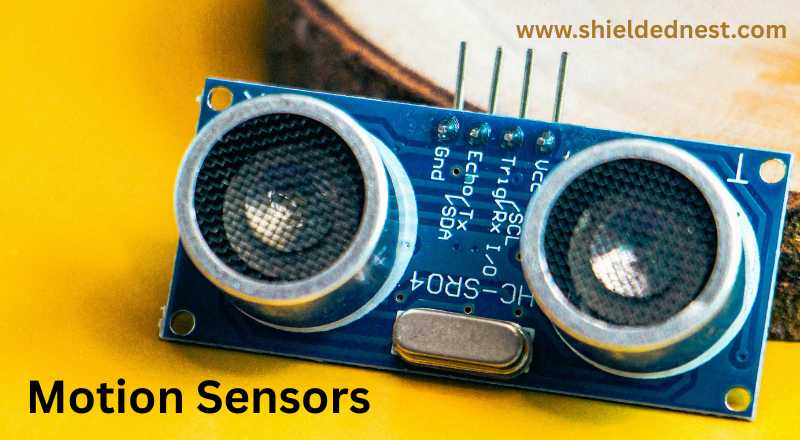
An ultrasonic motion sensor is another type of active motion sensor. They transmit high-frequency sound waves (above human hearing), which return to the sensor after bouncing off objects in their detection range. Ultrasonic motion sensors sense movement by timing, like how long it takes for sound waves to return from objects. AS sound waves are transmitted in all directions, this feature gives an excellent result in identifying the motion in three dimensions.
In addition to security alarm installations, ultrasonic motion detectors are used in automatic doors and parking lot gates frequently to identify approaching bodies.
Microwave Sensors
Microwave sensors induce microwave pulses, which is why they are considered active sensors. They transmit a constant stream of microwave radiation, generally in the range of 1 to 10 GHz, and the wave bounces off objects before returning to the sensor. These sensors identify movement by measuring the frequency and phase of their reflected pulses.
The greatest strength of microwave oven sensors is their capability to detect movement through solid objects, such as walls and doors. This capability makes them especially useful for covering the places out of line- of- sight area.
Microwave motion sensors are frequently used in automatic doors and motion activated-burglar alarm systems.
Passive Infrared (PIR) Motion Sensors
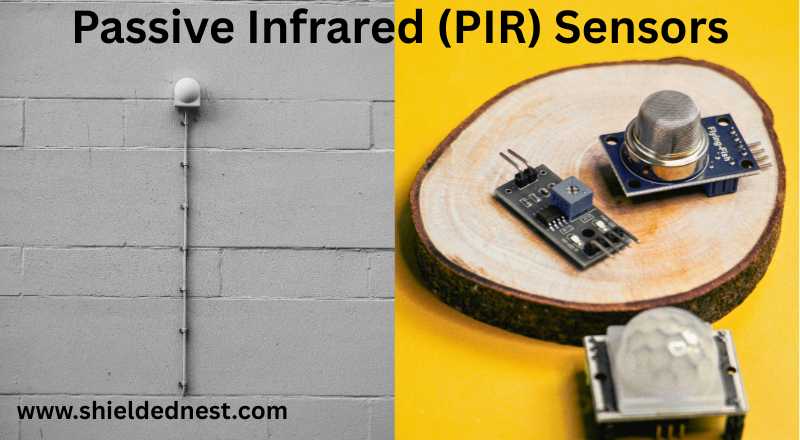
In contrast to ultrasonic and microwave motion sensors, passive infrared (PIR) sensors do not transmit any waves. Instead, they sense the movement through a pyroelectric sensor that senses the variations in infrared radiation that is naturally transmitted by living beings and objects that are warmer than absolute zero.
Passive infrared sensors serves excellent at detecting the movement of humans and animals, as living bodies transmit significant amounts of infrared radiation.
When an individual or object moves within the range of detection of a passive infrared sensor, the level of infrared radiation in that area changes, prompting the PIR sensor to activate an alarm or initiate another response.
Passive infrared sensors are mainly used for intrusion detection and to facilitate automated lighting systems.
Proximity Sensors
There are various types of proximity sensors available, such as inductive, capacitive, and photoelectric sensors.
Inductive sensors are designed to detect metallic objects, while capacitive sensors can identify non-metallic objects, and photoelectric sensors use light for object detection.
What is common in all proximity sensors is their capability to sense movement by transmitting signals that are either reflected or absorbed by objects within their detection range. They are known for their reliability, as they remain unaffected by environmental factors like temperature or humidity.
Proximity sensors were used in numerous applications, from detecting objects on production lines to sensing hands near touchscreen interfaces, as well as motion detection for burglar alarms and different parts of security systems.
Tomographic Sensors
A tomographic sensor generates electromagnetic radiation to produce three-dimensional (3D) images. These sensors are frequently utilized to obtain X-rays in medical laboratories as well as for scanning baggage and individuals at the airports.
The level of radiation emitted by these types of sensors is typically minimal and considered safe when applied in limited quantities.
The primary benefit of tomographic sensors is their ability to generate precise and detailed three-dimensional (3D) representations of the scanned regions.
Dual Sensors
A dual sensor functions by merging two distinct sensors, like a PIR sensor and a microwave sensor, into one unit. This combination of motion sensor technologies results in a reduction of false alarms that can be caused by environmental influences and interference.
For instance, a PIR sensor might activate due to a rapid temperature shift, whereas a microwave sensor could be activated by movement beyond its detection range. By requiring the activation of both sensor types, dual devices experience reduced false alarms.
Which Motion Sensor Type Is Best for Indian Homes?
Passive Infrared (PIR) sensors are the best all-purpose choice for interior lighting in most Indian homes because of its low cost, high reliability, and minimal false alarm rates.
They work especially well in bedrooms, hallways, and staircases. Microwave or dual technology sensors are suitable alternatives for more sensitive applications or for greater safety.
Key points to consider before buying
Sensor Technology: Passive Infrared (PIR) sensors are the best for indoor areas because they detect movement by sensing body heat. So whenever you need a motion sensor detector, only for indoor use, then the best preference is the PIR type.
Outdoor Security: Use Dual-Technology Sensors. Actually, dual technology is which combines two type of technologies together for getting optimum results. The best one for outdoor needs is a PIR and microwave Doppler radar combination. It gives the best detection and reduces false alarms
Installation: The traditional wired systems are time-consuming and expensive for installation. But nowadays, smart wireless systems are preferred for apartments as they do not require much labour, professional assistance, or extensive wiring.
Coverage: Always prefer sensors with a 90–180 degree (FOV) field of view, particularly for outdoor or very large rooms, where you need a wide-angle view.
Best Motion Sensors for Home Security in India
Best motion sensors for home security in India include reliable brands like Bosch and Schneider Electric, as well as smart choices like the Philips Hue Motion Sensor and TP-Link Tapo T100 for app-driven alerts and so man others.
The prices are in between ₹200 and ₹10,000+, key features include dual-tech (Integrated technologies ) for outdoor security and PIR technology for indoor movement detection.
Best Smart Sensor in Indian Market
What Are Motion Sensors?
Brand : Philips Hue Motion Sensor
Features :
o Exclusively for Philips Hue Smart Lights
o Requires Hue Bridge provision
o Easy installation – No complicated wiring needed
o Includes one Hue Motion Sensor and two AAA batteries in the package
o Automates your smart lights to respond according to the object’s movement
o Triggers the lights instantly after movement detection
o Mount anywhere in the home wirelessly using a magnetic mount
o Use the Hue app to customize your motion sensor according to the need
Check this product for further information
Best Budget/Compact Smart Sensor in Indian Market
Following is the selected product with best budget and compactness
Brand : TP-Link Tapo T100 120° PIR Smart Motion Sensor
Features :
o Motion-Activated Light
o Energy Saving
o Battery-Powered
o Real-Time Notifications
o Device Sharing
o Supports Wide Range Detection
o Captures motion up to 23 ft.(7m) away and through 120° view.
Check this product for further information
Best High-End/Outdoor Security
Following product is best for Higher end security application
Brand : Bosch Security Video DS794Z Motion Sensor for Security Systems
Features :
o High-quality PIR
o Motion Monitor
o TriTech (PIR + Microwave) detectors suitable for outdoors especially Gardens.
o PIR Detectors use Motion Analyzer signal processing to reduce false alarms
o Provides coverage integrity
o Field replaceable mirrored optics
o three different coverage patterns provide installation flexibility
Check this product for further information
Link: https://amzn.to/4cFDmHs
Other Top Reliable Brands available in the Indian market
The following are the other top brands available in the Indian market.
o Schneider Electric
o Honeywello Havells
o Sensinova
o Blackt Electrotech
o MAXWELL, etc.
Common Mistakes to Avoid When Buying
Not understanding how sensors work
Understanding the working principle of a motion sensor is very important. So, understand the above concepts well to avoid mistakes.
Ignoring detection range & coverage
Another important thing to consider is the range of detection and the coverage area. Too small a range creates dark zones, too wide a range triggers false alarms.
Wrong sensitivity & time delay
Take care of selecting the right sensitivity for lights, and also make sure the time delay is perfect. Lights turn ON from pets or turn OFF also quickly.
Using the same sensor everywhere
Avoid using the same sensors everywhere. Bathrooms, balconies, corridors, and kitchens need different types. Understand the requirement properly and choose accordingly.
Ignoring LED compatibility
Ignoring to consider LED compatibility can cause flickering or sensor failure.Not considering environmental conditions
Not considering environmental conditions
Always consider the environmental conditions like Heat, moisture, and airflow, which will affect the overall performance of the device.
Skipping smart features
Don’t compromise technology for money. The modern sensors are very intelligent; they can automate your lighting for your comfort.
Choosing low-quality sensors
Always buy reasonable quality sensors, don’t go for cheap ones. Cheap sensors lead to frequent problems and a short lifespan of the product.
Brand : TP-Link Tapo T100 120° PIR Smart Motion Sensor
Features :
o Motion-Activated Light
o Energy Saving
o Battery-Powered
o Real-Time Notifications
o Device Sharing
o Supports Wide Range DetectionCaptures motion up to 23 ft.(7m) away and through 120° view.
Check this product for further information
https://amzn.to/4u5WqpC
Installation Tips
While installing your smart motion sensors, you can save time and money by covering more space in your home with fewer sensors. There are a few suggested procedures to optimize the efficiency of each smart sensor, depending on the intended use and room location.
Installing in high pass through area
Placing your smart home sensors in hallways, living rooms, staircases, or any room with an unusually high pass-through rate is a brilliant idea. Because intruders always have to pass thiese path ways.
Facing or over a doorway
Following the same perspective, motion sensors perform well at gateways like your main entryway.To allow your smart sensor to quickly detect intruders entering your home, place the device directly in the front of the doorway.Do you want to use a more hidden method? Mount the motion sensor with its head down above your door. The sensor will be able to detect the stranger quickly, but the intruder wont be knowing it, unless the alarm sounds
Corners
Do you want your smart motion sensors to cover as much area as possible? The most suitable places to view the whole area are the corners. Some motion sensors come with a mount that fits nicely into any corner and offer a 180° detection angle.
Optimum Height to Mount
Naturally, it's important that your motion sensors get a clear view of the room or area in which they are installed. If it is positioned too low, it could get blocked, and if it is positioned too high, it may result in blind spots on the floor. For a large number of motion sensors, mounting it somewhere between two and two and a half meters from the floor should be optimal.
Maintenance tips
Key Maintenance Tips
Regular Cleaning: Gently wipe the sensor lens with a soft, microfiber cloth to remove dust and grime.
Clear Obstructions: Always ensure the detection zone is clean. Check that the branches, decorations, or hanging objects are within the detection zone, which could be the reason for false alarms.
Battery Replacement: Always check the batteries regularly. Replace the batteries in wireless sensors periodically within 2 years or whenever it indicates to be changed. Maintaining batteries regularly will maximize their performance.
Check Sensitivity & Settings: Test the detection range and time settings regularly. Adjust the setting for wind or heavy rain if necessary.
Inspect Mounting: Make sure the sensor is safely mounted and aimed properly at the desired coverage area to achieve maximum performance.
Moisture Protection: For outdoor usage, especially for lights, keep the housing tightly sealed to prevent water infiltration to avoid a short circuit.
Frequently Asked Questions (FAQ)
Conclusion
In this article, we have explored the Motion Sensors for Home Security in India, their working principle, types, installation tips, best available in the Indian market, etc.
Buying a motion sensor is a smart investment if you want to improve home security, increase energy efficiency, and enhance comfort in your home. Motion sensors are considered as very essential part of home security systems, because of their activities like automating in-home lighting, recording video, and triggering alerts. Moreover, they act as a link between the real world and the digital world.
Always check detection range, sensitivity, delay, and LED compatibility before buying.
Make the right choice today and enjoy a smarter, safer, and energy-efficient home tomorrow!
