
Introduction
Can you guess, how long a human can pay attention to watch an event? The study states that the average human attention span was found in the year 2004 to be 150 seconds, and it has been decreasing year after year, with a reduction to 47 seconds by the year 2021. It is possible for video security operators to become distracted and overlook an important incident when they are monitoring several video streams during their working shift.
Computer vision and artificial intelligence (AI) can offer security assistance in identifying and capturing hazards that an human operator might have overlooked.
Just think, have you ever missed an alert of a real intruder entering your home because your camera kept buzzing every time a cat walked by or too many false notifications came from a weaving tree branch? How disgusting it is?
That's exactly why AI CCTV cameras are considered an important device in home security now. They're not just cameras that record only footage. They actually think smartly. They watch, they analyze, and alert you only when something genuinely worth to your attention happens. It will easily eliminate the false alarms.
In this guide, we're going to explain what an AI CCTV camera is, how it actually works, what features matter, the honest pros and cons, and what the law says about using one in India. Whether you're a homeowner, a renter, or a small business owner, you'll walk away knowing exactly what to go for.
What Is an AI CCTV Camera?
Consider a normal traditional camera you are using; what will it do? It will simply keep on recording whatever is in front of the camera’s lens. That’s all it can do. If something had happened during the period, you would have to go back to the footage and manually check all the way to find out where and when the incident occurred.
But an AI CCTV camera works in a different way; on top of recording, it has the capability to analyze the footage in real time using AI (Artificial Intelligence) algorithms. It can easily differentiate between humans and animals and even it can recognize a familiar human face. When something happens, the AI analyses the footage and alerts you immediately only if it is genuinely required. It will not send false alerts.
How Does an AI CCTV Camera Work? (Simplified)
The following contents will help you to understand what is happening inside the camera when it is on operation.
1. Image Capturing
The camera captures video frames continuously, usually about 25–30 frames per second. Each captured frame is like a still photograph.
2. Edge AI Processing
Modern AI cameras use an edge AI processor, a tiny but powerful chip (like Ambarella, Qualcomm, or HiSilicon chipsets) inside the camera, to process the data within itself before sending the output to the cloud storage. This means the camera doesn't need to send every frame to a cloud server to analyze it; this happens locally, in real time, with very low time delay.
3. Deep Learning & Computer Vision
The AI uses a technique known as deep learning; if you want to know exactly, it is Convolutional Neural Networks (CNNs). These neural networks have been trained on millions of images or pictures to recognize, understand and keep in mind the patterns.
After training, they can identify the following:
•Human body movements and shapes clearly
•Different types of Vehicles (Two-wheeler, car, auto, jeep, lorry, etc.)
•They can recognize the license plates precisely
•They can understand Facial features (only with facial recognition models)
•Also, it can identify specific human behaviors like walking, jumping, running, falling, or moving here and there near cameras.
4. Object Detection & Classification
Once the AI focuses on anything in front of the lens, it classifies it in many ways. Like, what is the object? Is it a human? A pet? A vehicle? A shadow? A tree? Etc. This is where AI overcomes traditional motion detection. Old cameras detect any pixel change. AI cameras understand what caused that change.
5. Analysis of behaviour
Apart from detecting objects, the advanced AI cameras can understand the behaviors of humans. For example, they can tell if someone is•Walking normally or trying to hide around somewhere
•Standing for a long time in a restricted area without permission
•Leaving their belongings, especially a bag, unattended or leaving the bag behind and walking away.
•Fighting with each other, falling from the ground, pushing each other etc.
6. Alert Generation
Once a threat-level event is found, the system immediately sends a real-time alert or message to your smartphone, email, or connected security platform within 2–5 seconds from the time of event.
Key Features to Look For in an AI CCTV Camera
Remember, not all AI cameras are built with equal capabilities.
Following are the important that a good camera should have
Human & Vehicle Detection
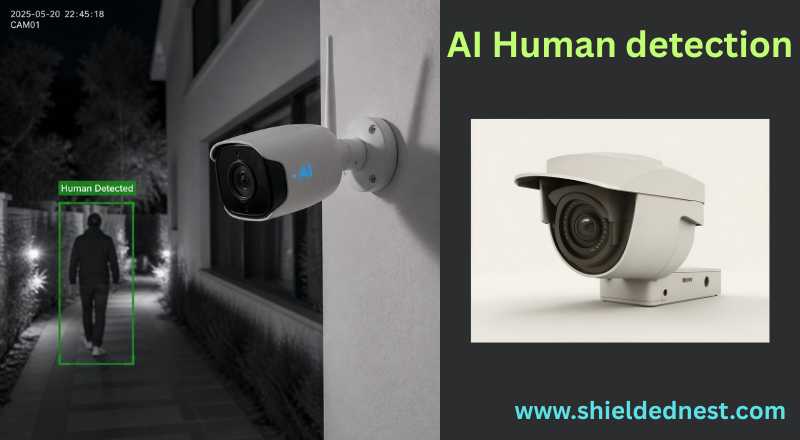
The AI camera can differentiate between the seen objects, it filters out animals, leaves, and other false triggers, which is not seriously required. It alerts you only when a real human or vehicle is detected at the spot.
Facial Recognition
The camera can identify the faces of your family members and only alert you when an unknown or strange face appears. Some latest models can even remember and recognize a previously seen person.
License Plate Recognition (LPR)
This very good option, it reads and logs vehicle plates entering your property. It is very useful for driveways and parking areas.
Behavioral Analytics
Identifies wandering persons, perimeter breaches, crowd formation, or abnormal movement patterns.
Two-Way Audio with AI Filtering
You can speak through the camera to the intruder and identify him; the intruder can also answer you from the camera. The AI filters out background noise to keep this two-way communication clear.
Night Vision with AI Enhancement
Instead of just using infrared (IR), AI cameras use an image processing facility to produce clear, color-accurate footage even in very low lighting.
Cloud & Local Storage
A better AI camera found in the market gives you the option of both cloud storage and local storage. Local storage (via SD card or NVR) records your footage even if the internet is unavailable.
Smart Search
Smart search is the great option comes with the latest AI cameras. Instead of searching through out the footage for hours to find an, you can use “smart search” option by describing the event like, "Show me all humans detected at the front door between 9 PM and 7 AM."
AI CCTV vs. Traditional CCTV - A Quick Comparison Table
Advantages of AI CCTV Cameras
1. Dramatically Fewer False Alarms
This alone is enough for the upgrade for most people. You will stop ignoring alerts because you know each one actually means something.
2. Faster Response Time
AI used to flag threats immediately after they occur. It is not like the traditional way of flagging the threats manually after watching the footage for hours.
3. Works round the clock without Fatigue
An AI system doesn't get tired as human gets tired working for any given time. The AI will not be distracted or bored with doing the same job for hours, like humans used to feel. It performs with 100% efficiency at 10 AM, just like at 10 PM, without any fatigue.
4. Smarter Evidence Collection
When an incident occurs, AI cameras make it easy to find exactly what you need quickly, thanks to the smart search and event tagging options.
5. Storage Efficiency
AI compresses unwanted footage (empty room, no activity places) more aggressively and stores only the wanted clips in higher quality, thus saving significant space on storage.
6. Scalable for Any Property Size
AI cameras can be configured to cover multiple areas with different set of rules for each area, such as a one-bedroom apartment or a big warehouse.
7. Integration with Smart Home Systems
Most modern AI cameras are compatible with Google Home, Amazon Alexa, Apple HomeKit, and smart locks, creating an integrated security ecosystem.
Disadvantages of AI CCTV Cameras
1. High Upfront Cost
AI cameras typically cost anywhere from ₹5,000 to ₹30,000+ per unit, compared to ₹1,500–₹5,000 for basic model cameras. The system setup cost is also comparatively higher than the basic models.
2. Subscription Fees for Full Features
Many brands have monthly subscriptions for using their cloud storage, smart alerts and facial recognition.
3. Privacy Concerns
Using the facial recognition feature in particular causes serious ethical and privacy issues. If cameras are pointed at public places, you may unknowingly collect biometric data of unknown people, which may violate the local privacy laws of the country.
4. Dependence on Internet & Electric Power
While Final AI works offline, most full-featured AI cameras require a stable internet connection for cloud backups, remote viewing, and software updates. A power outage or internet outage can create blind spots in the footage.
5. Complex Initial Setup
Compared to plug-and-play traditional cameras, AI systems often need a proper professional configuration for detection zones, sensitivity levels, and alert rules. Remember, a poorly configured AI camera is almost as bad as having no camera, so perfect configuration is important.
6. Cybersecurity Risks
Internet-connected cameras always have a risk that it can be hacked. So you have to take care when selecting passwords, because poor passwords or unencrypted communication may give space for hackers. Take caution when you use cheaper or uncertified brands.
What Does the Law Say? (Privacy & Legal Considerations)
Before you install an AI CCTV camera, it's important to understand the legal rules and regulations of the country, especially considering that these AI cameras are more powerful than traditional ones.
In India, the Government (MeitY) made a landmark move in 2026. From April 1, 2026, all CCTV cameras sold in India must carry STQC (Standardisation Testing and Quality Certification) and meet Essential Requirements (ER) under the Compulsory Registration Order. This ensures that every camera you buy has:
•Secure, encrypted firmware
•Protection against remote hacking
•Verified cybersecurity standards
(Source: Ministry of Electronics and Information Technology, Government of India — meity.gov.in)
This is good news for users. It means you need not worry about data leakage in any illegal ways.
Best AI CCTV Camera Options to Consider in 2026
1. CP Plus CP-E35Q
It is best overall for Indian homes. This product is made in India with CTC Cyber Secure technology. Offers AI-powered Smart Detection Suite, 360° Pan & Tilt, color night vision, and works with Alexa & Google Home.
2. Qubo Smart Cam 360° (2026 Edition
Best "Made in India" choice by Hero Group. STQC certified with AI Person Detection, Intruder Alarm, and color night vision. Stores footage on Indian cloud servers, and it is great for privacy-conscious buyers.
3. Imou IPC-K3DP-3H0WF Bullet
Best for outdoor AI surveillance. Provides outstanding 30 Mts color night vision with AI Human Detection and smart tracking. Excellent value at around ₹2,049 for a weather-resistant outdoor camera.
4. Dahua WizSense Series
Excellent for small business use. Solid human & vehicle detection with local NVR storage options.
5. Trueview 3MP 4G Mini PT
Best for areas with a weak Wi-Fi signal. Works on a SIM card with 4G support, so no router is needed. Features like All-Time Color Vision, AI Human Detection, 360° Pan, and being STQC certified and Alexa compatible are present.
Final Thoughts
AI CCTV cameras are one of the most practical home security upgrades you can make today. They're no longer considered just for big corporations or government buildings; now they're affordable, smart, and designed for everyday people’s use at their homes.
They're not doing any magic. Always keep in mind that a poorly placed, poorly configured AI camera won't protect you any better than a basic one. Take the time to set up detection zones properly, use strong passwords, check legal requirements in your area, and choose a brand with certified hardware.
The bottom line? If you're still running a traditional camera system that fires off 40 alerts a day, it's time to upgrade. An AI CCTV camera will actually alert you when it really matters and won't create false alerts. Don’t compromise your peace of mind for money.
Stay safe and choose smart.
Related Articles You May Find Helpful
Best WiFi Solar Cameras for Outdoor Security in India (2026)
CCTV Camera Installation Price for Home in India – Complete Cost Guide
10 Best Indoor Home Security Cameras Under ₹2000 in India
Top 10 Intrusion Alarm Systems in India for Safe Homes
Motion Sensors for Home Security in India – Ultimate Guide
5 Best Smart Locks with Video Doorbells in IndiaApartment Security Tips for Homes in India 2026
